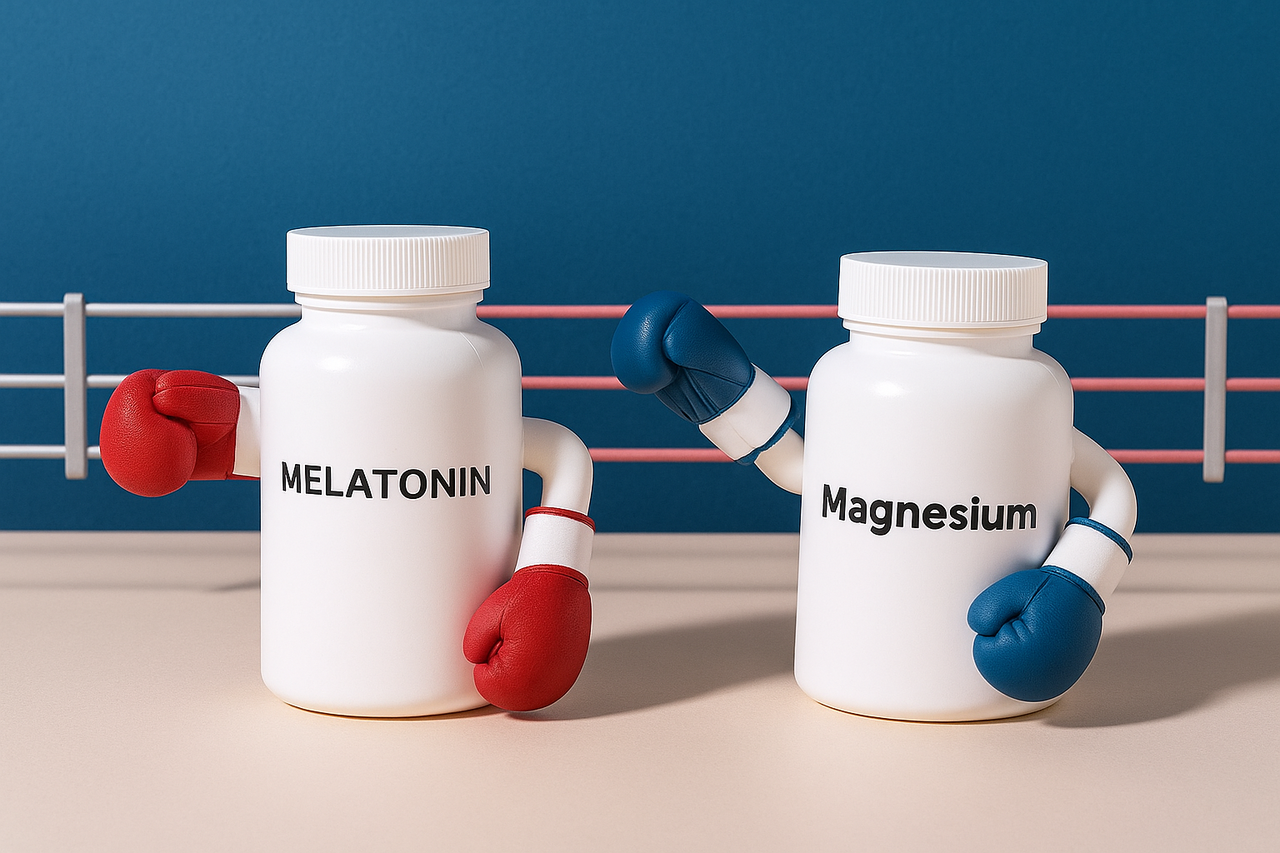

Magnesium vs. Melatonin: Which Sleep Aid Works Best?
Key Takeaways
The Difference: Melatonin is the "Starting Gun" that tells your brain to sleep. Magnesium is the "Brake Pedal" that physically relaxes your nervous system.
The Synergy: Taking them together is safe and often more effective than using either alone, as they address both sleep onset and sleep maintenance.
The Missing Link: Magnesium works best when paired with Vitamin B6, which helps transport it across the cell membrane for maximum absorption.
Walk down the supplement aisle of any pharmacy, and you are greeted by a confusing wall of bottles. On one side, you have Melatonin, the famous "sleep hormone." On the other, you have Magnesium, the trendy "relaxation mineral."
If you are struggling to sleep, you are faced with a dilemma: Do I take the hormone to fall asleep? Or the mineral to relax? Can I take both? Or will that make me too groggy?
The truth is, sleep is a complex biological process that requires more than just one switch to be flipped. Melatonin and Magnesium do completely different things in the body, and understanding the mechanics of each is the key to finally getting the rest you deserve.
This comprehensive guide will break down the science of the "Sleep Stack," why they work better together, and the specific dosages used by pros.
Part 1: Melatonin (The "Starting Gun")
Melatonin is perhaps the most misunderstood supplement in the world. Many people treat it like a "natural sedative" or a sleeping pill. They pop a gummy and expect to be knocked out cold in 20 minutes.
But Melatonin is not a sedative. It is a chronobiotic—a time-giver.
How It Works:
Your pineal gland naturally produces melatonin when the sun goes down. It binds to receptors in the brain to signal: "It is dark outside. Stop hunting. Stop working. Prepare for rest."
Think of Melatonin as the Starting Gun of a race. It tells the runners (your body) to start the race, but it doesn't actually run the race for you. If you take melatonin but then stare at a bright blue screen, you are effectively firing the starting gun while holding up a stop sign. The signal gets confused.
When to Use It:
- Jet Lag: When your internal clock is out of sync with the sun.
- Shift Work: When you need to sleep while the sun is up.
- Delayed Sleep Phase: When you are a "Night Owl" trying to become a "Morning Person."
Part 2: Magnesium (The "Brake Pedal")
If Melatonin is the signal, Magnesium is the mechanism. It is an essential mineral involved in over 600 enzymatic reactions in the body, but its role in sleep is physical.
Magnesium acts as the body's natural Brake Pedal. It competes with Calcium (which excites nerves) to bind with receptors that calm the nervous system down.
The "GABA" Connection:
One of Magnesium's most critical roles is supporting the production of GABA (Gamma-Aminobutyric Acid). GABA is a neurotransmitter that quiets nerve activity. Without enough Magnesium, your brain can get stuck in a "switched on" state, leading to those racing thoughts ("Popcorn Brain") that keep you awake at 2 AM.
Physical Relaxation:
Magnesium also helps de-tense tight muscles. If you are an athlete, or if you carry stress in your shoulders and jaw, a Magnesium deficiency can make it physically uncomfortable to lie still.
The Verdict: Should You Take Them Together?
The short answer: Yes.
In fact, taking them separately is often why people feel their sleep aids "don't work."
The Problem with Melatonin Alone:
You might fall asleep quickly (because of the signal), but if your cortisol is high or your muscles are tense, you will wake up at 3 AM unable to fall back asleep. Melatonin helps with Onset, not Maintenance.
The Problem with Magnesium Alone:
You might feel relaxed and heavy, but if your circadian rhythm is out of whack (from blue light or travel), your brain won't initiate the sleep cycle. Magnesium helps with Maintenance, not always Onset.
The Synergy:
By stacking them, you cover both bases. You give the brain the signal to start sleeping (Melatonin), and you give the body the fuel to stay relaxed and asleep (Magnesium).
The Missing Link: Vitamin B6
Here is a secret that most supplement companies ignore: Magnesium is hard to absorb.
You can take a high dose of Magnesium, but if your cells can't uptake it, it just passes through your system (often causing digestive issues). This is where Vitamin B6 comes in.
Research suggests that Vitamin B6 acts as a "cellular shuttle" for Magnesium, significantly increasing its absorption rate. Furthermore, B6 is a cofactor required for the body to synthesize its own Melatonin and Serotonin naturally. A sleep stack without B6 is like a car without spark plugs—it has the fuel, but it won't ignite.
The "Som Stack": Why We Combine Them
We realized that buying three different bottles (Melatonin, Magnesium, B6) is annoying, expensive, and hard to dose correctly. That is why we engineered the Som Sleep Formula to be the ultimate "All-in-One" stack.
We didn't just throw ingredients in a blender. We carefully balanced the ratios to mimic the body's natural requirements:
1. The Signal (3mg Melatonin):
We use 3mg because studies show this is the "Goldilocks" dose—enough to trigger sleep, but not so much that you feel groggy the next day.
2. The Mechanics (Magnesium Citrate + B6):
We use Magnesium Citrate specifically for its high bioavailability and rapid absorption speed. Paired with Vitamin B6, it reaches your nervous system faster than cheaper forms of the mineral.
3. The Bridge (L-Theanine + GABA):
We added two more powerhouses. L-Theanine (found in green tea) promotes Alpha Brain Waves (the state of "flow" and calm), while extra GABA helps quiet the electrical noise in a busy mind.

Berry Sleep Aid Drink Mix
10-Pack, 0 Sugar

Cherry Sleep Aid Drink Mix
10-Pack, 0 Sugar
Safety & Protocol: How to Use the Stack
If you are ready to try this combination, follow these best practices to ensure safety and effectiveness.
1. Timing is Everything
Take your stack 30 minutes before bed. This is the precise window needed for the nutrients to enter your bloodstream just as you are finishing your wind-down routine.
2. Consistency Matters
While Melatonin works immediately, Magnesium levels build up over time. You may feel "better" after night one, but you will feel "restored" after week one as your mineral deficiency is corrected.
3. Watch the Dosage
Do not exceed recommended doses. More Melatonin (e.g., 10mg) does not make you sleep "harder"; it often just desensitizes your receptors and causes vivid nightmares. Stick to the 3mg range.
Conclusion
You don't have to choose between falling asleep and staying asleep. By understanding the unique roles of Melatonin and Magnesium, you can create a sleep routine that addresses the full spectrum of rest. If you are tired of the guessing game, Som Sleep offers a pre-measured, science-backed solution trusted by over 100 pro sports teams to get the job done.
Frequently Asked Questions
Is Magnesium better than Melatonin?
It is not "better"—it is just different. It’s like asking if water is better than food. Melatonin sets the timing for sleep (Circadian Rhythm), while Magnesium relaxes the muscles and nervous system to maintain sleep. Most people need both.
Can I take Magnesium and Melatonin every night?
Yes. Magnesium is an essential mineral that your body needs daily, and small doses of Melatonin (like the 3mg in Som Sleep) are generally considered safe for nightly use to maintain a consistent sleep schedule.
Will taking both make me groggy?
Grogginess is usually caused by taking too much Melatonin (5mg+) or taking it too late at night. A balanced formula taken 30 minutes before bed typically results in waking up refreshed, not groggy.
Why does Som Sleep use Magnesium Citrate?
We chose Magnesium Citrate specifically for its superior bioavailability. This form is absorbed by the body faster and more efficiently than other forms (like Oxide), ensuring the mineral reaches your system during the critical wind-down window.